Lorenz
Drag to orbit
Interactive story·6 min read
The Lorenz Attractor and the Butterfly Effect
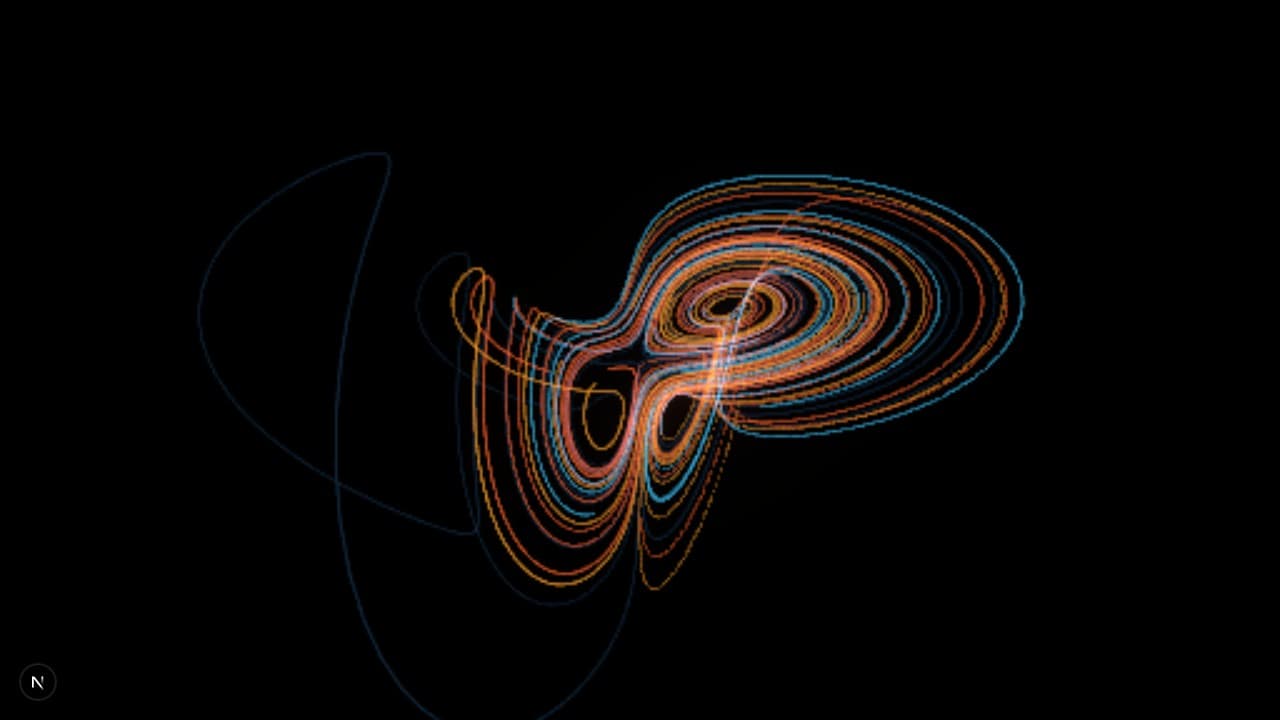
The shape behind these words is not a video. It is a tiny universe being computed live in your browser, and it will follow this story as you scroll.
Scroll to begin ↓
Chapter 1
Weather, reduced to three numbers
In 1963, the meteorologist Edward Lorenz threw away almost everything we call weather. No clouds, no wind maps, no coastlines. What survived is a universe with just three numbers tied together by three simple rules: how fast the air stirs, how the temperature differs across it, and how the heat escapes.
What you are watching is that entire universe evolving in real time. Every curve of light is the "weather" moving from one state to the next.
The whole universe on your screen is these three lines:
The variable is the speed of the stirring, is the temperature difference, is the distortion of the heat profile. The dot means "how this changes in the next instant". Notice what is not in there: no dice roll, no noise, no randomness of any kind.
Chapter 2
Two storms, a hair apart
A second trajectory just appeared. The blue storm starts 0.0008 away from the orange one. Same rules, same equations, same everything, except for that microscopic head start.
Watch them for a moment. They agree, they shadow each other, and then, without warning, they betray each other completely. Lorenz found this by accident: he re-entered a number from a printout rounded to three decimals, and his simulation invented a different future.
Chapter 3
Turn up the heat
The system you are watching just changed. One single number moved: the heating parameter rose from 28 to 47. Same laws, more energy.
One dial, and the whole personality of the universe changes. That is what sensitivity means: in a chaotic system, small causes are not small for long.
In the original convection problem, (rho) is the Rayleigh number: it compares how strongly the fluid is heated from below against how well it can dissipate that heat. Below about 24.74, the Lorenz system settles into a fixed point, meaning steady convection. Above it, no steady state survives and the trajectory wanders forever. You can feel this yourself in the free play at the end: slide down and watch the storm die into a spiral.
Chapter 4
Look closer
We zoomed in. Notice two things that seem impossible together. The path never repeats itself, ever, and yet it never leaves this butterfly-shaped region. It is infinitely long, drawn inside a finite box, and it never crosses its own trail.
An object like this is called a strange attractor. "Attractor" because trajectories fall into it from almost anywhere. "Strange" because up close it is not a surface but an infinitely fine mille-feuille of layers: a fractal.
Chapter 5
Deterministic is not predictable
Every point of this path was computed from exact rules with zero randomness. Given today, tomorrow is fully determined. And yet after a short while, no computer on Earth can tell you where the trajectory will be, because no measurement of "today" is ever infinitely precise.
That gap between two words we usually treat as synonyms, deterministic and predictable, is one of the deepest discoveries of the 20th century. It is why weather forecasts are excellent at day 2, decent at day 5, and folklore at day 15.
Nearby trajectories separate roughly like , where is the largest Lyapunov exponent. For the classic Lorenz parameters, , so the distance between the twins multiplies by about every time units. Your measurement error does not add up over time. It compounds, like interest. Doubling the precision of your instruments buys you only extra time units of trustworthy forecast.
The story is yours now.
Change the parameters, follow a connection, and see what happens.
Enter the playgroundBack to projects